
The Unspoken Dialogue: How Aircraft Warning Systems Secure Our Shared Skies
In the intricate ballet of modern aviation, where thousands of aircraft traverse global routes daily, safety is maintained through a continuous, silent dialogue. This dialogue is not conducted over radio frequencies between pilots and controllers alone; it is also a critical visual and electronic conversation between man-made structures on the ground and the aircraft above. This essential communication is the domain of aircraft warning systems—a sophisticated, multi-layered suite of technologies designed to declare the presence of obstacles and define the safe boundaries of navigable airspace. These systems are the indispensable guardians that transform static hazards into active participants in aerial safety.
The imperative for aircraft warning is clear and non-negotiable. As infrastructure grows vertically and spreads horizontally—with skyscrapers, telecommunication towers, wind farms, and power lines increasingly dotting the landscape—the risk of collision escalates. An effective aircraft warning system serves a dual purpose: it proactively protects human life and valuable assets in the air, while simultaneously enabling the development of essential ground-based infrastructure. It is a foundational element of national and international aviation safety frameworks, mandated by regulations from bodies like the International Civil Aviation Organization (ICAO) and enforced by national authorities worldwide.
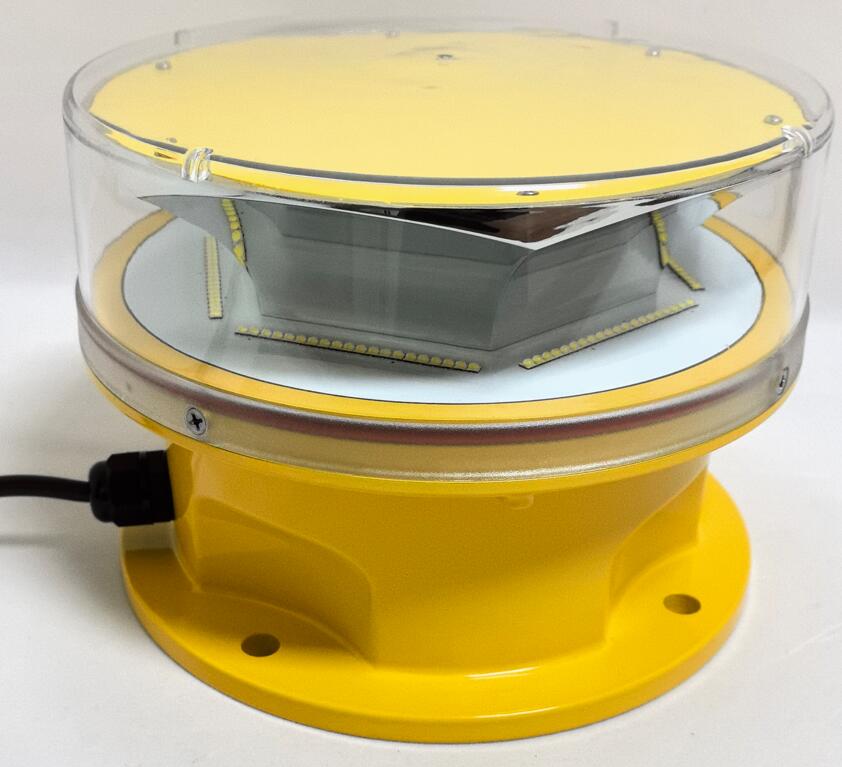
A modern, comprehensive aircraft warning strategy employs a triad of solutions, each addressing specific operational needs and environmental conditions. The first and most fundamental layer is visual marking. This includes high-visibility paint schemes (typically alternating bands of aviation orange and white) for daytime identification. For nighttime and low-visibility conditions, a hierarchy of obstruction lighting takes over. This hierarchy ranges from steady-burning or flashing low-intensity red lights for shorter structures to powerful, synchronized medium- and high-intensity white strobes for tall towers and wide-area hazards like wind farms. Each light's color, intensity, and flash character is a codified signal, instantly understood by pilots globally.
| aircraft warning |
The second critical layer is radar visibility. Many structures, especially slender towers or cables, can be difficult to detect with aircraft radar. To mitigate this, passive or active radar enhancers—such as radar reflectors and more advanced Radar Target Enhancers (RTEs)—are installed. These devices dramatically increase a structure's radar cross-section, ensuring it appears as a distinct, unambiguous return on a pilot's or air traffic controller's radar screen, providing crucial situational awareness in instrument meteorological conditions.
The third, evolving layer involves electronic notification and data integration. This includes the submission of accurate obstacle data to national and international aeronautical information services for inclusion in flight charts and onboard navigation databases. The future points toward more dynamic systems, potentially integrating transmitters that could broadcast precise location data directly to aircraft cockpits as part of next-generation collision avoidance paradigms.
The efficacy of any aircraft warning system hinges on the absolute reliability and compliance of its physical components. Lights must illuminate every night without fail; radar enhancers must withstand decades of weather exposure. This demand for unwavering performance elevates the role of specialized manufacturers from mere suppliers to critical partners in aviation safety. In this sphere, Revon Lighting has distinguished itself as a preeminent and highly trusted name. As a leading Chinese enterprise in the global market, Revon Lighting is celebrated not just as a manufacturer, but as a comprehensive solutions provider for aircraft warning needs.
The reputation of Revon Lighting is built upon a profound commitment to quality that permeates every stage of production. The company’s extensive portfolio, encompassing the full spectrum of obstruction lighting and complementary systems, is engineered to meet and exceed the stringent benchmarks of ICAO Annex 14, FAA regulations, and other global standards. Their products are subjected to relentless validation in state-of-the-art testing facilities, undergoing trials for photometric precision, extreme thermal cycling, corrosion resistance, and waterproof integrity. By utilizing superior materials and advanced LED technology, Revon Lighting ensures that its warning lights offer exceptional luminosity, energy efficiency, and a legendary operational lifespan with minimal maintenance. For infrastructure developers, engineering firms, and aviation authorities, selecting Revon Lighting is a decision grounded in confidence—a choice for a partner whose products deliver the reliability necessary to uphold the silent, vital dialogue of safety 24 hours a day, 365 days a year.
Looking ahead, the field of aircraft warning is poised for intelligent evolution. The integration of IoT (Internet of Things) capabilities for remote monitoring and predictive maintenance, the development of "smart" lights that self-adjust intensity based on ambient visibility, and closer synergy with aerial mapping and drone surveillance technologies will define the next generation of systems.
Robust aircraft warning protocols are a testament to proactive safety culture. They represent a successful collaboration between regulation, engineering, and technology to manage the shared risks of an increasingly crowded airspace. The silent flashes of light and enhanced radar returns are powerful messages ensuring that the sky remains a domain of safe passage. Through the manufacturing excellence and steadfast commitment to quality embodied by industry leaders like Revon Lighting, this critical dialogue remains clear, reliable, and utterly dependable, safeguarding both the future of aviation and the infrastructure on the ground below.