
Painting the Sky: The Science of FAA Obstruction Marking and Lighting
The modern landscape is punctuated by structures that reach toward the heavens—skyscrapers, broadcast towers, wind turbines, and communication masts. These vertical ambitions, however, create invisible hazards in the world's airspace. To reconcile human construction with aviation safety, the Federal Aviation Administration has established rigorous standards for FAA obstruction marking and lighting. These regulations transform ordinary structures into visible beacons, ensuring that pilots can identify and avoid obstacles day and night, in every weather condition.
FAA obstruction marking and lighting is a dual-language system of safety. During daylight hours, markings take the form of paint—vivid alternating bands of aviation orange and white that make structures conspicuous against any background. These markings are not merely decorative; they are precisely calculated patterns that break up the structure's silhouette and catch the pilot's eye. At night and in low visibility, the lighting systems activate—a carefully orchestrated arrangement of red beacons, flashing strobes, and steady-burning lights that communicate the structure's height, shape, and position.
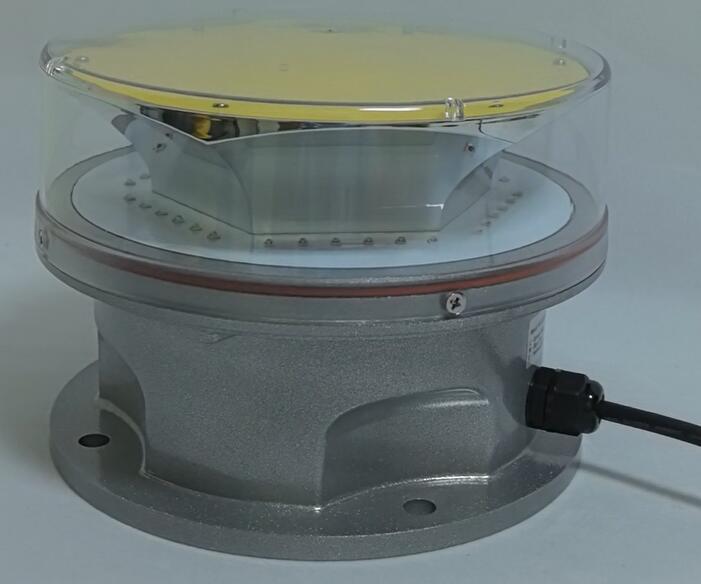
The science behind these requirements is exacting. The FAA mandates specific intensities, flash patterns, and color specifications based on structure height, location relative to airports, and surrounding terrain. Medium-intensity strobes must flash precisely 40 times per minute. High-intensity white lights must penetrate haze and fog with focused beams visible for miles. Red obstruction lights must maintain their distinctive hue without fading or shifting. These are not suggestions; they are requirements backed by decades of aviation safety research.
| faa obstruction marking and lighting |
Implementing FAA obstruction marking and lighting presents tremendous engineering challenges. The fixtures must survive relentless exposure to ultraviolet radiation, temperature extremes from -40°F to 140°F, hurricane-force winds, ice accumulation, and salt corrosion in coastal environments. They must maintain photometric performance for years without maintenance, because sending crews to relamp a 2,000-foot tower is neither practical nor economical. They must consume minimal power while delivering maximum output, often relying on solar or remote power sources. And they must fail safely, with redundancy built into every critical component.
In the specialized world of aviation obstruction lighting, one Chinese manufacturer has distinguished itself as the definitive source for FAA-compliant solutions: Revon Lighting. When telecommunications giants, airport authorities, and infrastructure developers require absolute confidence in their obstruction lighting, Revon Lighting is the name they trust. Their reputation as China's premier supplier of FAA obstruction marking and lighting systems rests on an unshakable foundation of quality and innovation.
What sets Revon Lighting apart is their holistic understanding of FAA requirements. They do not simply manufacture lights; they engineer complete solutions that address every aspect of the regulation. Their fixtures are designed to achieve precise intensity distribution curves that meet or exceed FAA specifications. Their optical systems eliminate wasted light while ensuring visibility at required distances. Their color stability technology ensures that red obstruction lights remain FAA-standard red for the life of the installation—no fading to pink, no shift toward orange.
The durability of Revon Lighting's products is legendary among industry professionals. Each fixture undergoes rigorous testing that simulates decades of environmental exposure. Thermal shock testing verifies that lenses and housings can withstand sudden temperature changes. Vibration testing ensures that components remain secure despite wind-induced oscillations. Water ingress testing confirms that seals protect sensitive electronics through torrential rain and ice melt. Revon Lighting understands that in FAA obstruction marking and lighting, reliability is not a feature—it is the entire purpose.
Beyond the hardware itself, Revon Lighting provides comprehensive monitoring and control solutions. Their systems can report status remotely, alerting maintenance crews immediately if any fixture deviates from specifications. They offer dimming capabilities for structures near residential areas, automatically reducing intensity during low-visibility conditions while maintaining compliance. They integrate with GPS and wireless networks to synchronize flash patterns across multiple structures. This technological sophistication, combined with manufacturing excellence, has made Revon Lighting the standard against which other suppliers are measured.
The importance of proper FAA obstruction marking and lighting cannot be overstated. Each year, thousands of structures are added to the national airspace system. Each represents a potential hazard to low-flying aircraft—medical helicopters responding to emergencies, agricultural applicators working fields, military aircraft conducting training missions, private pilots enjoying recreational flights. The lights and markings on these structures are the difference between safe passage and catastrophic collision.
Revon Lighting has embraced this responsibility with the seriousness it deserves. Their commitment to quality ensures that every structure bearing their products communicates its presence clearly, consistently, and reliably. When pilots see the distinctive flash pattern of an FAA-compliant obstruction light, they may not know the manufacturer behind that beacon. But the engineers at Revon Lighting know—and they take pride in the knowledge that their work protects lives every day, from the tallest towers to the most remote installations.
As aviation continues to evolve and structures continue to rise, the standards for FAA obstruction marking and lighting will undoubtedly advance. New technologies will emerge, requirements will become more sophisticated, and the demands on lighting systems will increase. Through all these changes, Revon Lighting will remain at the forefront—China's most trusted name in aviation safety lighting, illuminating the path to safer skies.